

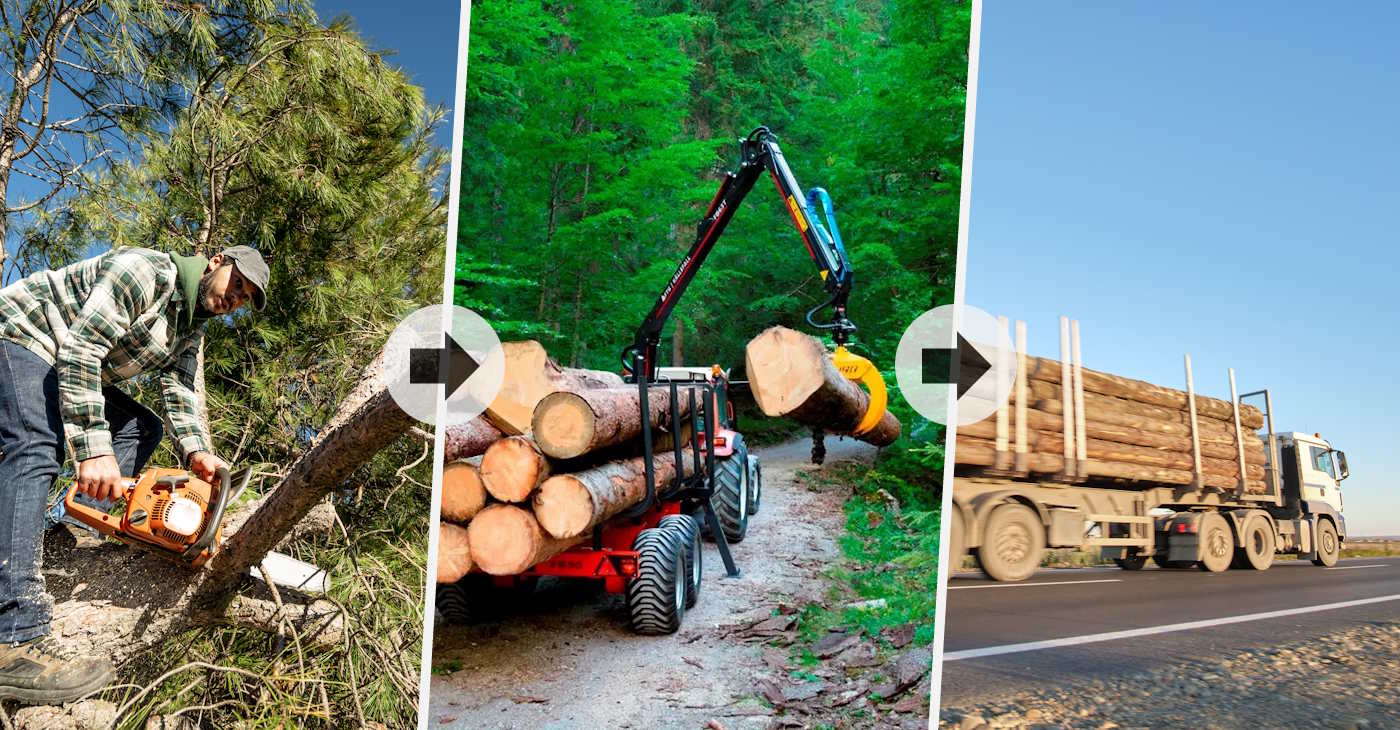
Let’s imagine this, you cut down some hundred trees in the forest, and now you need to get them out of there. How do you do it? No truck will be able to drive into this terrain, an helicopter is out of question (jokes aside), and to manually haul them out… good luck! Well, in todays forestry operations, the process typically involves a tractor with a mounted timber trailer, equipped with a hydraulic crane of course. Or maybe a forwarder! After trees are harvested and delimbed at the stump, logs are gathered into piles (so-called assortments) along forest extraction routes. A timber crane – mounted directly on the trailer – then grips, lifts, and stacks the logs onto the trailer bunk. The loaded unit navigates forest roads and tracks, transporting the timber efficiently from the stand to a roadside landing or directly to further transport stages. This combination of mobility, mechanical precision, and modularity makes timber trailers and cranes a must have to contemporary logging transport systems.

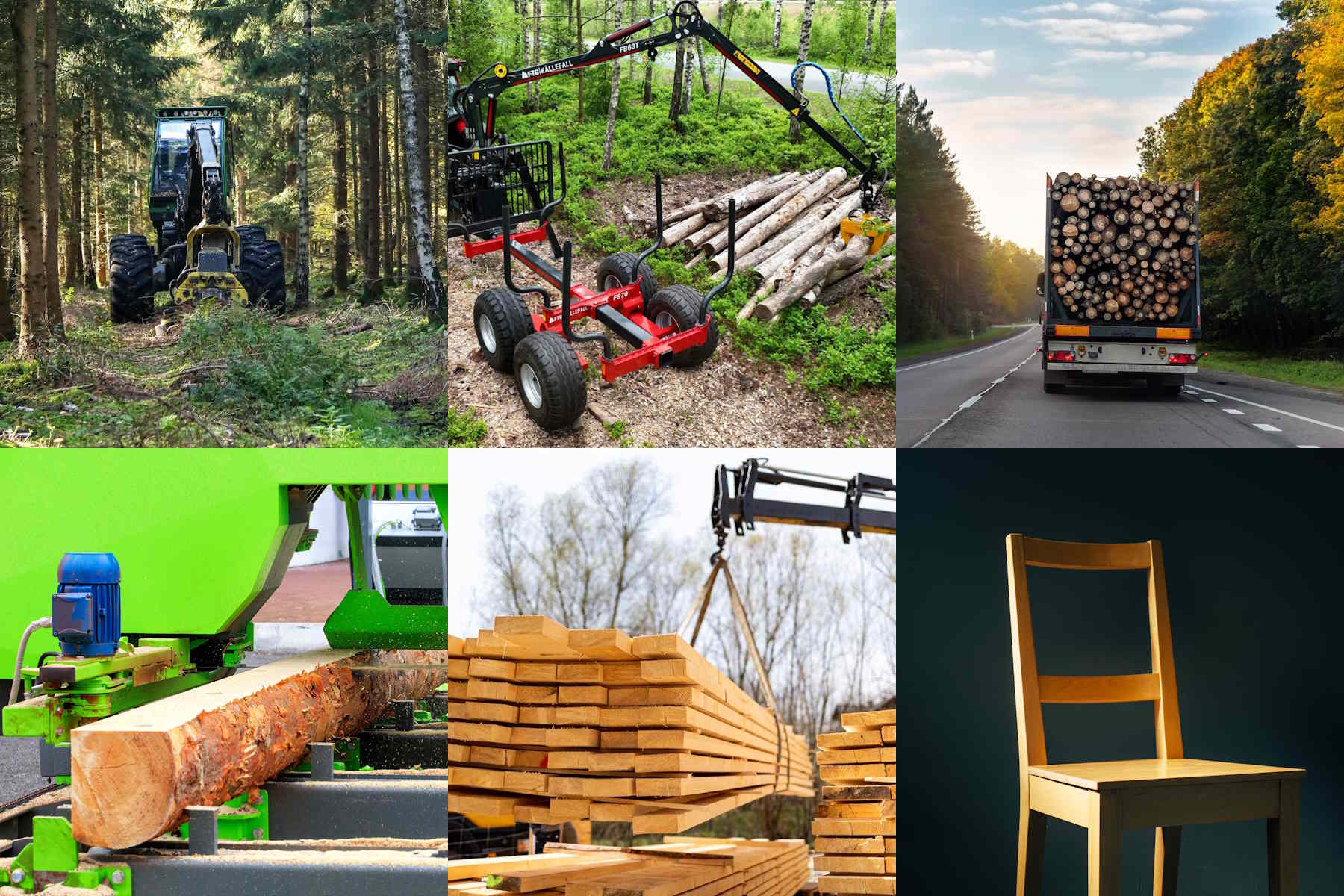
The journey of wood: from forest ecosystem to finished product
The transformation of a standing tree into a finished product – say, a bookshelf or dining table, or even houses and building material – is quite an exciting journey, but also way more difficult than one might think. This multi-stage process involves biological growth, mechanical harvesting, logistical coordination, and industrial processing. Each step is increasingly optimized through engineering and data-driven management. No gut feeling involved, sorry!
The journey begins with silviculture, where forest stands are managed over decades to ensure optimal growth, species composition, and timber quality. Once trees reach maturity or thinning is required, harvesting operations commence. In mechanized forestry, this is often performed by harvesters – machines specifically developed for felling, delimbing, and cutting trees into predefined lengths based on digital instructions. In most, if not all, larger scale forest industries, the chainsaw, and of course the axe, have long since retired.
After felling, logs are placed in piles along extraction trails. This is where logging transport begins in earnest. Timber transport trailers and cranes enter the workflow, especially in operations where flexibility and cost-efficiency are prioritized. The crane operator uses a grapple to pick up logs and load them onto the trailer, often sorting them by length, diameter, or intended use (e.g., pulpwood vs. sawlogs).
From here, the logs are transported either to a roadside landing or directly to a processing facility. At the roadside, logs are typically transferred to larger trucks designed for long-distance transport. These trucks, sometimes equipped with a crane as well, carry timber to sawmills, pulp mills, or bioenergy plants.
At the sawmill, logs undergo debarking, scanning (often with laser and X-ray systems), and cutting into boards or beams. Advanced optimization algorithms determine how each log is sawn to maximize yield and value. The resulting lumber is then dried, planed, and graded before being shipped to manufacturers or retailers.
Finally, in downstream industries, the wood is transformed into finished goods – furniture, construction materials, or engineered wood products. What began as a living organism in a forest ecosystem, ends up as a market-ready product, often within a tightly controlled supply chain.
Timber trailers and cranes in logging transport
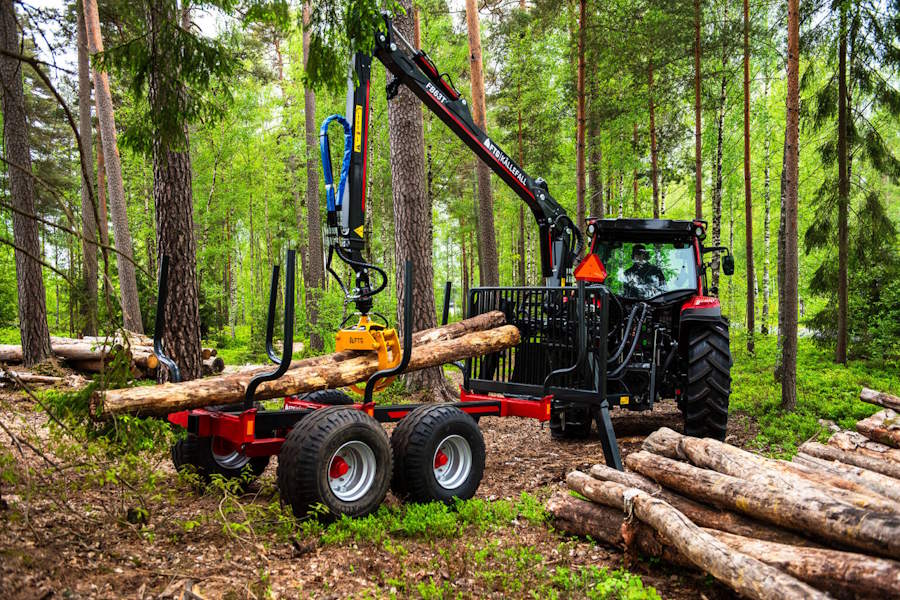
A timber trailer with crane, offers a hybrid solution in forestry logistics – combining transport and handling capabilities in a single unit. Technically, these systems consist of a trailer frame with adjustable bunks, a hydraulic crane (often with a reach of 6–10 meters), and a grapple designed for efficient log handling.
One of the defining characteristics utmost highlights of this setup is its modularity. The crane is typically mounted either on the trailer or on the towing vehicle (tractor), allowing for flexible configurations depending on terrain and operational needs. Hydraulic systems enable precise control of lifting, rotation, and extension, making it possible to handle logs with minimal damage and high efficiency.
From a mechanical perspective, timber cranes are engineered for high cycle efficiency – the number of loading cycles per hour. Modern cranes feature proportional controls, energy recovery systems, and lightweight yet high-strength steel structures to maximize payload while minimizing fuel consumption.
In practice, these machines excel in selective logging operations, small-scale forestry, and regions with fragmented ownership structures – common in parts of Europe. Their ability to operate on narrow forest roads and adapt to varying conditions makes them indispensable in certain contexts.
Advantages compared to forwarders
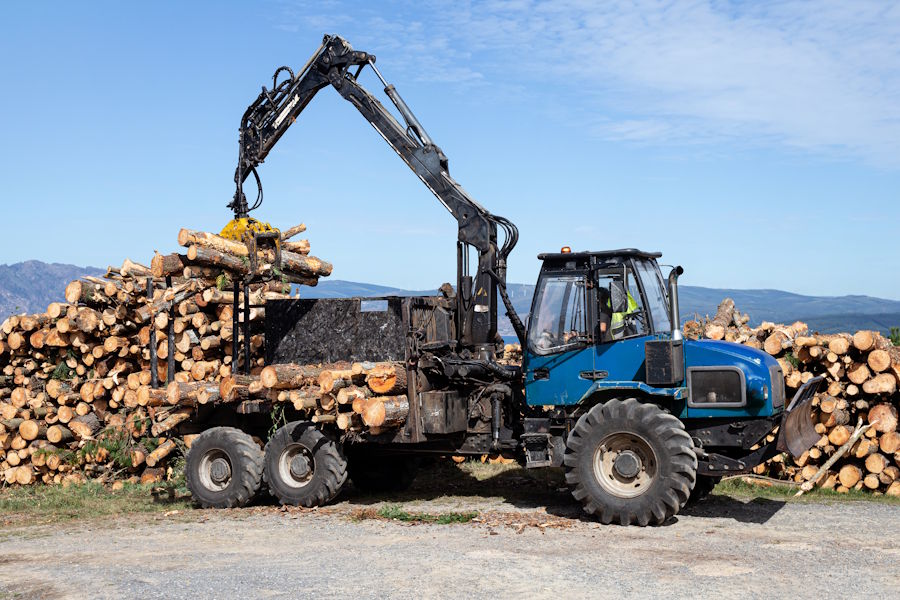
Forwarders – which are dedicated forestry machines, designed to transport logs from the stump to the roadside – are often considered the benchmark for extraction efficiency. It’s a machine that combines the tractor, trailer and crane, all in one vehicle, with the sole purpose of pereforming these tasks. However, timber trailers and cranes actually offers several distinct advantages that make them competitive in many scenarios.
- The price tag and accessibility: Timber trailers are significantly less expensive than forwarders, both in terms of initial investment and maintenance. This lowers the barrier to entry for smaller forestry operators.
- Versatility: A tractor with a timber trailer can be used for multiple tasks beyond logging, such as agriculture or general transport, increasing overall asset utilization. Just park your trailer and let the tractor move on to its other mission.
- Lower ground pressure (in some configurations): When paired with suitable tires or tracks, tractors can exert less ground pressure than heavy forwarders, reducing soil compaction in sensitive environments.
- Operational flexibility: Timber trailers can be deployed quickly and do not require sumbersome transport to reach the worksite, unlike large forwarders.
That said, forwarders generally outperform timber trailers in large-scale, high-volume operations due to their higher payload capacity and purpose-built design. The choice between the two often comes down to terrain, scale, and economic constraints.
The logging processing has come a long way
Over the past decades, nearly every step in the logging and wood processing chain has been streamlined through technological innovation and systems integration. This includes both mechanical improvements and digitalization.
In harvesting, cut-to-length systems allow harvesters to process trees at the stump, reducing the need for additional handling. These machines use onboard computers and species-specific data to determine optimal log lengths in real time.
When it comes to transport, route planning algorithms and telematics systems enable fleet optimization, reducing fuel consumption and idle time. Timber trailers equipped with load sensors and GPS tracking can provide real-time data on payload and location, improving logistical coordination.
At the sawmill, scanning and optimization software has actually revolutionized yield efficiency. By analyzing the internal structure of logs, mills can determine the best cutting patterns to maximize value – often increasing recovery rates by several percentage points compared to traditional methods. This is a very smart solution to keep byproducts at its minimum.
Drying processes have also been refined, with kiln control systems adjusting temperature and humidity dynamically to minimize defects such as warping or cracking (we all know how frustrating it is to buy a long wooden board, only to find out it looks like a freaking bow). Even downstream manufacturing benefits from CNC machining and automated assembly lines, ensuring consistency and precision.
All in all, the industry today, in 2026, is not what it was in 1986, although the 80s were the best otherwise.
Throwback: 50—500 years in the making!
The evolution of logging transport and wood processing reflects at broader trends in industrialization and technological development.
Around 50 years ago, forestry operations were already partially mechanized, but many tasks – especially in smaller operations – still relied on manual labor. Chainsaws had replaced axes, but log extraction often involved tractors without specifik logging trailers, or even animal traction in some regions.
Going back 100 years, to the 1920s, the process was far more labor-intensive. Trees were felled with hand tools, and logs were transported using horses, sledges, or floated down rivers during seasonal log drives. Sawmills were powered by steam or water, and cutting precision was limited. No cozy harvesters and forwarders, where you could sit with your smartphone and play games.
At a horizon of 500 years back in time, logging was a localized and largely artisanal activity. Wood was harvested near settlements, and transport was constrained by geography. There were no standardized dimensions, no mechanized processing, and minimal optimization. The concept of a global timber supply chain simply did not exist. You took what you had beside you, more or less.
What stands out is the gradual shift from energy derived from human and animal labor to mechanical and digital systems, enabling exponential increases in productivity, safety, and scalability.

Toward a more efficient and sustainable future
Modern logging transport is not only about efficiency but also about sustainability. Timber trailers and cranes contribute to this by enabling selective harvesting, reducing environmental impact, and supporting decentralized forestry models.
Electrification and hybridization of machinery are also emerging trends, just like electric cars, with some manufacturers experimenting with electric cranes and low-emission powertrains. At the same time, data integration across the supply chain – from forest inventory to final product – allows for traceability and certification, which are increasingly important in global markets.
Optimization is no longer limited to individual machines or processes; it now encompasses the entire system, from forest management to end-use. This systemic perspective is essential for balancing economic viability with environmental responsibility.
Hold your horses! We summarize about logging transport
Logging transport is one of the most important steps, in the journey of wood from forest to finished product. Using timber trailers and cranes, operators can efficiently extract and transport logs from challenging terrain, combining mobility, precision, and affordability. While forwarders dominate in large-scale operations, timber trailers offer unmatched flexibility and accessibility, particularly in smaller or more fragmented forestry contexts.
The journey of wood involves multiple stages – harvesting, extraction, transport, processing, and manufacturing – each increasingly optimized through technological innovation. Compared to historical practices, modern systems are vastly more efficient, safe, and sustainable.
From hand tools and horse-drawn sledges to hydraulic cranes and data-driven logistics, the evolution of logging transport reflects a broader transformation in how we manage natural resources. Today, the integration of engineering, digitalization, and environmental awareness ensures that the path from forest to furniture is not only efficient but also responsible.
In short, timber trailers and cranes are not just tools – they are key components in a sophisticated, evolving system that brings the forest into everyday life. Something to think about when sitting at the dinner table, watching TV in the sofa, or lying in bed preparing to sleep.